The Making of Overdue
I wanted the Library to have a game. Not a quiz or a click-to-reveal page, but something you could sit with for an hour, the way you'd sit with a book. What came out of that is The Unfound Library: Overdue, a free puzzle game that starts cozy and doesn't stay that way.
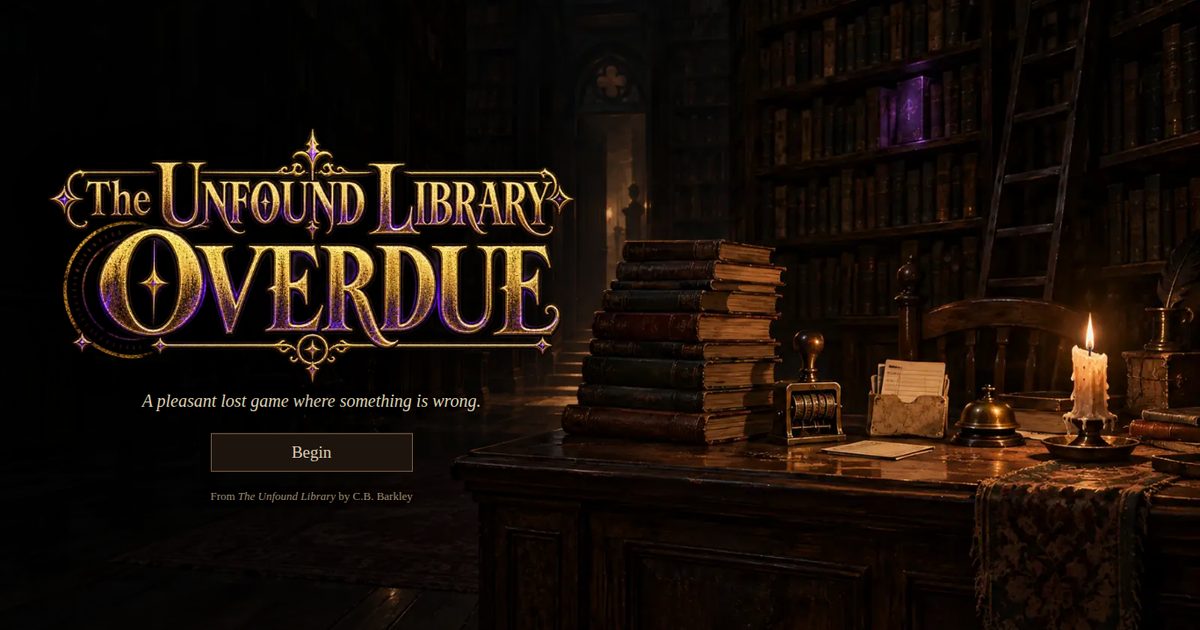
A pleasant lost game where something is wrong
That line became the whole design brief. Match-3 games are about as friendly as games get: bright pieces, satisfying cascades, nothing at stake. I loved the idea of using that comfort as a disguise. You sit down to sort some books after closing. The candle is lit, the shelves are quiet, and the work is pleasant. Then, very slowly, small things stop adding up.
The Unfound Library has always been the part of the store that's a bit off, so the game had to be set there. It's after hours, the returns have piled up, and you're the one who stayed late to put the lost Tomes back where they belong.
Six pieces, six jobs
The shelf holds six kinds of pieces: Tomes, Keys, Crystals, Gears, Notes, and Lanterns. Early on, only the Tomes mattered, and that felt wrong to me. Why would anyone care about matching Keys if Keys did nothing? So every piece got a purpose. Keys open locked cubbies. Gears stop clocks that run backward. Notes sing along with a music box. Lanterns, Crystals, and Gears charge up power-ups. Now every match is a small decision, and the shelf feels like a place with rules instead of a pile of shapes.
One new idea per shelf
Chapter One has ten shelves, and each one adds exactly one new idea. Shelf II locks Tomes away in their cubbies. Shelf III chokes the shelf with dust. Shelf IV has a crack in the back wall, and if you make a match that touches it, something comes out. By the time you reach the last shelf, you're juggling everything at once, and you've learned it all one piece at a time.
Every shelf was tested with hundreds of simulated playthroughs to tune the number of moves, so the early shelves are gentle and the later ones push back without feeling unfair.
Rules for the wrongness
The horror in Overdue follows a few rules. The early oddities have to be deniable: a book opens an eye, once. A catalogue number doesn't fit the sequence. You could talk yourself out of having seen it. The wrongness also never gets in the way of playing; it never hides instructions or makes a shelf impossible. And anything strange can be seen again, so you can go back and check that you really saw what you think you saw.
It escalates slowly. Lanterns gutter. A music box plays a phrase slightly wrong. The lights flicker and show you a room that isn't there. And on the last shelf, the Library starts talking.
The look and the sound
The art direction was simple to say and hard to get right: dark, painted, candlelit, never pixelated. Warm light only where the candle reaches, and deep shadow everywhere else. The title screen is a returns desk at night, with a stack of overdue books, a date stamp, a library card, and a little brass bell. Look at it long enough and the scene changes when you aren't quite looking.
The soundtrack was written for the game, one track per stretch of the story. It starts quiet with The Door Behind the Store and ends in what I can only describe as cosmic chaos, with The Static Room, The Clock Runs Backward, and The Library Speaks carrying the last three shelves. Play it with the sound on.
Why it's called Overdue
It's a library word, and it's a little bit of a threat. Something has been waiting too long. Maybe it's the books. Maybe it's you.
What comes next
Chapter One is the quiet part. In the chapters after it, the Library stops hiding. The whispers get louder and start talking to each other, the shelves begin to move on their own, and the place comes alive. The torn pages you find in the walls are the thread that ties it all together, so hang on to them.